Garage Door Off Track: What to Do First, and Whether to Fix It Yourself
Published August 26, 2026 · Written by Abdul, Lead Technician · Open Sesame Garages OKC
Stop using the door right now — do not press the button again and do not force it by hand. An off-track door is no longer carried by both tracks, so its weight has shifted onto the lift cables and the spring system in a way neither was designed for, and every additional cycle bends track and creases panels. Clear people and cars away, secure the opening if the door is stuck open, and call a technician. The one narrow case where a homeowner attempt is reasonable is a fully closed door sitting flat on the floor with a single top roller out, both cables taut, and no bent track or damaged panel.
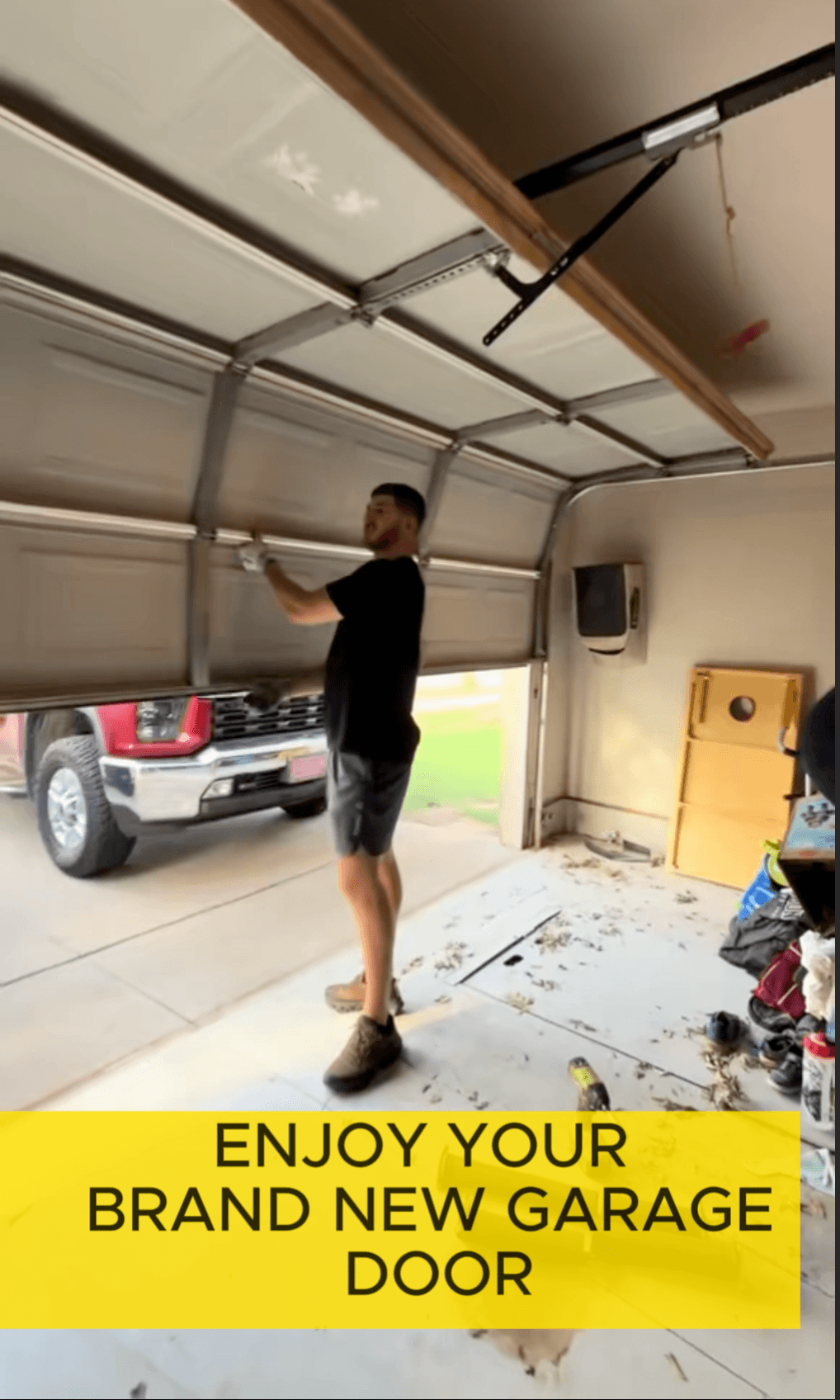
“My garage door came off the track” covers an enormous range. It can mean one roller sitting a half inch outside its channel on an otherwise perfect door, and it can mean a door folded against the header hanging on one cable. That range is why phone quotes for this repair are worthless, and it is also why the internet advice on it is so bad: half the articles tell you never to go near it, and the other half walk you into a cable job that genuinely can hurt you.
Here is the version we would give a neighbor.
The first five minutes
What you do in the first few minutes determines most of what this repair will cost. Not metaphorically — the difference between a reseat and a panel replacement is usually the number of times the button got pressed after it happened.
1. Stop pressing the button
This is the whole ballgame. A door that is off track but undamaged is an hour of work. The same door after four more attempts to run it has bent track, a creased panel, and possibly a cable off its drum. Nothing about the situation improves by trying again.
2. Do not force it by hand either
A door out of its track is no longer supported the way it was designed to be, and shoving it up or down transfers that load into whatever is still holding — usually a single cable or a bent track lip. Leave it where it is.
3. Clear the area and keep it clear
Move cars out from under it if they can be moved safely, and keep children and pets out of the garage entirely. Residential doors run from about 150 to 350 pounds, and an off-track door is one that has already demonstrated it can move in ways nobody planned.
4. Think before pulling the emergency release
If the door is stuck partway, the red release cord disconnects it from the opener — but if the springs or cables are also compromised, disconnecting the trolley can let the door drop. If you pull it, stand well clear of the door’s path and never underneath it.
5. Secure the opening if the door is stuck open
An open garage is an open house. Park a vehicle across the drive, lock the interior door into the home, and treat it as an emergency call rather than something to sort out tomorrow.
6. Take three photos
One of the track where the rollers came out, one of the cables at the bottom brackets on both sides, and one of the whole door from a few feet back. Send them when you call — they are what lets a technician bring the right parts on the first trip.
Why an off-track door is different from every other DIY repair
Replacing a middle roller or tightening a hinge is a static job. The door is closed, the springs sit at their normal load, and nothing is in an unusual state. An off-track door is the opposite: the entire system is out of its designed geometry, and every component is loaded in a direction it was never engineered for.
The lift cables are the specific hazard. They run from the bottom brackets to the drums on the spring shaft, under full tension whenever the door is not resting on the ground. When a door racks sideways, one cable can go slack and unwind off its drum while the other takes the door’s entire weight on one corner. Freeing a jammed roller in that state can release the whole load at once, with a hand in the middle of it.
DASMA — the trade association for the companies that manufacture this hardware — is explicit that cables and bottom brackets are connected to the spring system, are under extreme tension, and should be handled only by a trained door systems technician. Many manufacturers now fit tamper-resistant fasteners on those brackets specifically to keep homeowners out of them. An off-track repair very often ends up involving one or both.
The one case where a homeowner attempt is reasonable
We would rather describe this honestly than pretend it does not exist. If every one of the following is true, a careful homeowner can reasonably have a look:
- The door is fully closed and resting flat on the floor, so the springs are at their relaxed position and the ground is carrying the weight.
- One top roller — not a bottom one — has come out of its track.
- Both cables are taut and still seated correctly on their drums.
- No section of track is bent, spread, or pulled off the wall.
- No panel is creased, split, or separating from its hinges.
- The opener is unplugged and the trolley disconnected.
Even then: clamp locking pliers to the track below a roller so nothing can travel, work only with the door down, and stop the instant you find yourself levering hard. High resistance means something else is wrong, and the answer to that is never a longer pry bar. When the roller is back in, do not run the opener — lift the door by hand a foot or two and watch both sides travel evenly first.
Stop and call if any of these are true
- A cable is slack, frayed, kinked, or has jumped off its drum.
- The door is stuck partway, tilted, or hanging lower on one side than the other.
- A panel is creased, split, or pulling away from its hinges.
- The track is bent, spread open at a seam, or pulled off its wall bracket.
- You heard a bang before the door went off track — that is a spring or a cable, and the door now carries its full weight with no help.
- The repair involves the bottom bracket at floor level in any way. Those bolts are under full spring tension and the manufacturers’ own trade association says they are for trained technicians only.
- The door is a commercial rolling steel door, a high-lift installation, or anything running on a jackshaft operator.
What knocks a door off its track in the first place
| Cause | How you can tell | What the repair usually includes |
|---|---|---|
| Vehicle impact | A dent or scuff on a panel, a bent bottom section, the door out on the struck side | Track straightening or replacement, rollers, sometimes a panel |
| Broken lift cable | One side dropped, a loose cable hanging, the door racked at an angle | Cables replaced in pairs, drums re-seated, spring inspection |
| Worn or failed rollers | Months of grinding and jerking beforehand, black dust under the track | Full roller set, hinge check, track cleaning |
| Bent or loose track | A visible kink, a gap at a seam, bolts backed out of the wall bracket | Track section replaced and realigned, hardware retightened |
| Obstruction in the track | A door that hesitated at one spot for a while before it jumped | Debris removed, track inspected, rollers checked for damage |
| Broken spring | A loud bang first, then the door drops or feels impossibly heavy | Springs replaced in pairs, cables and drums checked, door rebalanced |
Notice how many of these gave warning. Grinding rollers, a door hesitating at the same spot, a cable starting to fray — off-track doors are usually the last chapter of a story that started months earlier.
What the professional repair involves
The order matters more than the parts list. The door is secured and the load taken off it before anything is freed. Then the rollers, hinges, cables, drums, and track get inspected; damaged track is straightened or replaced; the door is reseated square in both tracks; the cables are re-tensioned and seated evenly on their drums; and the door is rebalanced so it holds its position when released halfway.
The last step is the one that decides whether you call again in three weeks: identifying and fixing the cause. A door that came off because a roller disintegrated needs rollers. One that came off because a cable snapped needs cables and a hard look at the springs. One that came off after a bumper strike needs the track and often a panel. A reseat with no diagnosis is a temporary result, and we will tell you which one you are buying.
Every repair ends with two tests: the balance test, and a reversal test on the safety sensors. If a technician leaves without doing both, the job is not finished.
What it costs in the OKC metro
A straightforward reseat with no damaged parts typically runs about $150 to $350. What moves it is what broke on the way out: replacement cables usually add $150 to $250, a bent track section $150 to $400, a full roller set a similar range, and a creased panel is the expensive one at roughly $250 to $800 or more per section depending on the door. After-hours emergency dispatch carries a fee quoted before a truck rolls.
Repairing beats replacing in almost every case. Even a repair covering cables, a track section, and rollers is a fraction of a new door. Replacement only enters the conversation when several panels are creased, the door is old enough that matching panels are no longer produced, or the same door keeps coming off because the opening itself is out of square — and in that last case, replacing the door without correcting the opening just resets the clock.
Commercial doors and bays
On a commercial bay the calculus changes in two ways. The hardware is heavier — rolling steel doors, high-lift track, and jackshaft operators are not homeowner territory under any circumstances — and the cost of downtime usually dwarfs the cost of the repair. A bay that cannot close is a security exposure at the end of a shift; a bay that cannot open is a shipping problem at the start of one.
Impact damage from forklifts and delivery trucks is the leading cause on commercial doors, and it is also the most preventable: bollards at the jamb, a working photo-eye system, and a scheduled inspection interval based on cycle count catch most of it before a bay stops. If you run multiple doors, ask about scheduled commercial service rather than paying emergency rates for the same failure twice a year.
Frequently Asked Questions
My garage door is off track — should I fix it myself?
In almost every case, no. An off-track door has already shifted its load onto the lift cables and spring system in a way they were not designed for, and freeing a jammed roller can release that load suddenly. The one narrow exception is a fully closed door resting flat on the floor with a single top roller out, both cables taut and seated, and no bent track or creased panel. Anything beyond that is a call.
What causes a garage door to come off its track?
Five things account for nearly all of them: a vehicle bumping the door, a broken lift cable letting one side drop, worn or disintegrated rollers finally letting go, bent or loose track from age or a hardware failure, and an obstruction in the track that forces a roller over the lip. A broken spring can also cause it indirectly by making the door drop faster than the track can guide it.
How much does off-track garage door repair cost in Oklahoma City?
A clean reseat with no damaged parts typically runs about $150 to $350 in the metro. Replacement cables usually add $150 to $250, a bent track section $150 to $400, and a creased panel is the expensive one at roughly $250 to $800 or more per section. The full price is quoted after looking at the door and before any work starts.
Can I still open my garage door manually if it is off track?
You should not try. Manual operation assumes the door is being guided by both tracks and balanced by the springs, and an off-track door is neither. Pulling on it is how doors come down. Leave it where it sits and use a different exit until it is repaired.
Is an off-track garage door an emergency?
Treat it as one if the door is stuck open, hanging at an angle, blocking a car you need, or securing a business. A door stuck safely closed with the household able to come and go can usually wait for a standard next-day appointment, which costs less than an after-hours call.
How long does it take to put a garage door back on track?
A straightforward reseat is often under an hour, including inspecting the cables and rollers, squaring the door, and rebalancing it. Add time when track sections, cables, rollers, or panels have to be replaced.
Will insurance cover an off-track garage door?
Sudden accidental damage such as a vehicle strike is often covered; wear-and-tear failures such as aged cables or worn rollers generally are not. Photograph the damage before the repair and ask your carrier. We provide itemized invoices describing the cause, which is what adjusters ask for.
Door Off Track Right Now?
Leave it where it is and call. Open Sesame Garages runs 24/7 emergency dispatch across Oklahoma City, Edmond, Norman, Moore, Midwest City, Yukon and Mustang, for homes and for commercial bays — with the full price quoted before anything gets touched.
Sources
- DASMA, “Safety Tips For Garage Door Systems” — cables and bottom brackets are under extreme spring tension and should be handled only by a trained door systems technician; monthly balance checks and an annual professional inspection.
Related reading
- My garage door came off its track — what should I do?›
- Should I fix an off-track garage door myself?›
- How much does off-track garage door repair cost in OKC?›
- When should garage door rollers be replaced?›
- Is it safe to fix a broken garage door spring myself?›
- 24/7 emergency garage door repair costs & dispatch›
- Commercial garage door repair & overhead installation›
- Garage door maintenance checklist for Oklahoma homes›