Garage Door Roller Replacement: When It Is Worth It (and When It Is Not)
Published August 3, 2026 · Written by Abdul, Lead Technician · Open Sesame Garages OKC
Replace your garage door rollers when the wheels are worn flat, cracked, or wobbling on their stems, or when the door grinds instead of squeaks — not simply because someone told you black plastic rollers are junk. Nylon rollers with bearings are the quietest and cheapest meaningful upgrade on an older door. But the two bottom rollers sit in brackets that are under full spring tension, and those are a technician’s job, every time.
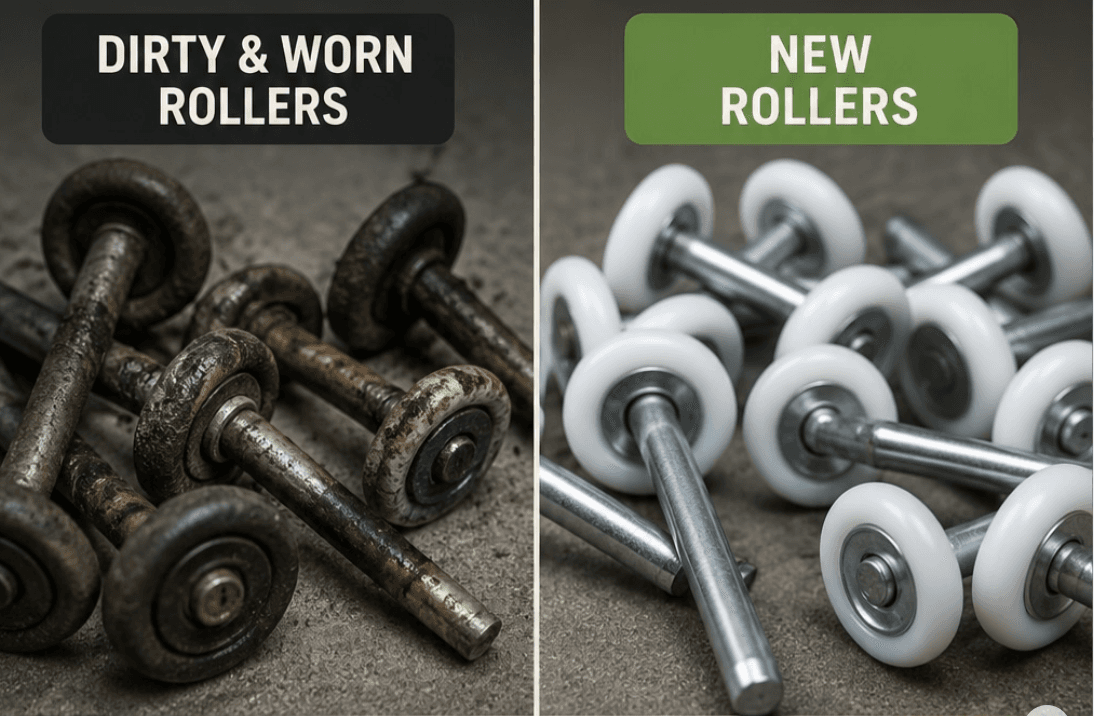
Noisy garage doors do not happen overnight. The rollers above came out of a single home in the OKC metro, and every one of them started out looking like the set on the right. Rollers are the parts that actually carry your door through the track, they are among the cheapest components on the whole system, and they are the first thing worth checking when a door that used to be quiet turns loud. They are also, unfortunately, one of the most oversold parts in the trade — so this guide covers both halves: how to tell when they are genuinely finished, and when someone is selling you hardware you do not need.
What a garage door roller actually does
Each roller is a small wheel — usually two inches across — on a steel stem that slides into a hinge or bracket on the door. The wheel rides inside the track; the stem carries the door’s weight into that wheel. A standard four-section, seven-foot residential door has roughly ten of them: two in the bottom brackets, two at each of the hinge rows, and two in the top fixtures. Every open and close is one cycle, and every cycle puts the whole weight of a 150–300 pound door through those ten small wheels.
When a roller stops rolling freely, it starts dragging. Dragging is what you hear as grinding, and it transfers load into the hinges, the track brackets, and the opener — which is the real argument for replacing worn rollers. It is not that a bad roller will strand you in the driveway. It is that a set of bad rollers quietly makes every more expensive part on the door work harder.
Five signs your rollers are genuinely worn out
The wheel is worn flat, chipped, or out of round
A healthy roller wheel is a clean circle. Look for flat spots, cracked nylon, or steel wheels worn to a shine on one side. A flat-spotted wheel bumps its way up the track every single cycle, and you can usually hear it before you can see it.
The roller wobbles or the wheel spins loose on the stem
Grab a roller with the door closed and try to rock it. Real play between the wheel and the stem means the bearings are gone. From that point the wheel stops rolling and starts skidding along the track, which chews up the track and loads the hinges.
Loose ball bearings, grease streaks, or black dust
Bearings that have failed will shed. If you find loose ball bearings on the garage floor, dark grease smeared down the inside of the track, or fine black dust under the vertical track, something is coming apart.
The door is grinding, not squeaking
A squeak is usually dryness and a lubricant fixes it. A grind or a rumble that gets louder as the door travels is metal riding on metal — worn rollers or a failing opener gear. Squeaks are maintenance; grinding is wear.
The door travels crooked or jerks at the curve
If the door hesitates or shudders at the curved section of track where the vertical rail turns horizontal, rollers that no longer spin freely are a common cause. So are bent tracks and a door out of balance, which is why this symptom is worth an actual inspection rather than a guess.
One useful distinction: a door that got loud gradually is wearing out. A door that got loud overnight had something change — a spring, a cable, or a roller that jumped its track — and that is a call, not a maintenance task.
Nylon vs. steel: what the manufacturers’ own engineers say
This is where most roller articles turn into a sales page, so here is the sourced version. In a piece published by DASMA — the Door & Access Systems Manufacturers Association, the trade body for the companies that actually build this hardware — engineers from Amarr, Clopay, Wayne-Dalton, Canimex and Arrow Tru-Line were asked directly about the claim that black plastic rollers are inferior and should be replaced. Their answers are not what a roller upsell would predict:
- Bearingless nylon rollers are rated at roughly 50 pounds per roller for no less than 10,000 cycles on a standard eight-foot door, and one manufacturer reported internal testing to no less than 22,000 cycles at that load. As Canimex’s roller product manager put it, people underestimate the bearingless nylon roller.
- Nylon is quieter than steel — that part of the pitch is true. Wayne-Dalton’s research director confirms nylon rollers are "a lot quieter than steel rollers."
- But a steel ball-bearing roller adapts better to a slightly misaligned hinge than a bearingless nylon roller does. There is a real trade-off, not a clean winner.
- The premium 13-ball nylon roller is rated by its own manufacturer at 75 pounds for 15,000 cycles on a twelve-foot door — a strong product, but "lasts forever" is marketing, and Clopay’s engineering director notes that in his testing no two rollers perform equally regardless of ball count.
- "Nylon 6" is not a special material. Per Wayne-Dalton, nylon 6 or nylon 6/6 is what essentially everybody in the industry uses, including the cheap black rollers.
The honest summary: upgrade to nylon rollers with bearings because you want a quieter door and a part that will not rust, and because on a heavier door or one that cycles constantly the bearings genuinely earn their keep. Do not do it because a technician pointed at the color of your existing rollers. On a light pan door that opens twice a day, the ones you have may be doing their job exactly as designed.
How long do garage door rollers last?
Rollers are rated in cycles, not years, and one cycle is one open plus one close. Common residential ratings run from about 10,000 cycles for bearingless nylon and basic steel rollers up to roughly 15,000–20,000 cycles for premium sealed-bearing nylon with a high ball count. Translating that into years depends entirely on your household:
| Cycles per day | 10,000-cycle roller | 20,000-cycle roller |
|---|---|---|
| 2 (one car, light use) | ~13 years | ~27 years |
| 4 (typical family) | ~7 years | ~13 years |
| 6 (two drivers, kids) | ~4.5 years | ~9 years |
| 10 (home business, teens) | ~3 years | ~5.5 years |
Rough arithmetic on published cycle ratings, not a warranty. Heat, grit, and a door that is out of balance all shorten these numbers — and in Oklahoma, dust and summer heat are not hypothetical.
The 15-minute check you can do yourself
Half the doors we get called about for “bad rollers” are actually dirty tracks and dry bearings, and that is a fix you can do with a rag and the right can of lubricant.
1. Close the door and cut the power
Put the door fully down and unplug the opener. Everything below is an inspection, not a repair — nothing you do here should require loosening a single bolt.
2. Look at every roller you can safely see
A standard four-section, seven-foot residential door runs about ten rollers: two in the bottom brackets, two at each hinge row, and two in the top fixtures. Walk the door with a flashlight and check each wheel for the five signs above. Stay off the ladder for anything you cannot reach comfortably.
3. Wipe the track — do not grease it
Tracks get cleaned, not lubricated. A rag and a little household degreaser to clear dirt and old grease is right; a coat of oil in the track just collects grit and makes the problem worse. Most "noisy roller" complaints are partly a dirty track.
4. Lubricate the bearings, hinges and springs
Use a lubricant made for garage doors, not WD-40 — WD-40 is a solvent and strips the grease you want to keep. Hit the roller stems and bearings, the hinge pivots, and the springs. On nylon rollers, lubricate the bearing at the stem, not the nylon wheel itself. Sealed-bearing and bearingless nylon rollers need nothing on the wheel at all.
5. Do the balance test
With the opener still disconnected, lift the door by hand to about waist height and let go. A balanced door stays roughly where you put it. If it slams down or shoots up, the spring system is off — stop there and call a technician. DASMA recommends this check monthly, plus a professional visit once a year.
6. Run it and listen
Reconnect the opener and cycle the door twice. If it is quiet, you had dirt and dryness, not worn rollers, and you just saved yourself a service call. If the grinding is still there, the parts are worn and it is time for a quote.
When to stop and call a professional
The middle and top rollers on a garage door come out with a screwdriver and some patience. The bottom two do not, and this is the single most important thing on this page. The bottom brackets that hold those rollers are bolted to the lift cables, which are under the full tension of the door’s spring system. DASMA’s safety guidance is explicit: because the bottom brackets are connected to the springs, they are under extreme tension and should be adjusted or loosened only by a trained door systems technician. Many manufacturers now fit tamper-resistant hardware on those brackets specifically to stop homeowners from opening them.
Call someone if:
- The rollers you want replaced are the bottom two, or the bottom bracket needs to come loose for any reason.
- The door fails the balance test — it slams down or drifts up when you let go of it halfway.
- A cable looks frayed, kinked, or has come off its drum. DASMA says cables are replaced by a trained technician only.
- A roller has come out of the track, or the track itself is bent or spread apart at a seam.
- You hear a bang and the door suddenly feels impossibly heavy — that is a broken spring, not a roller.
- The door is under warranty. Swapping hardware yourself can void it, and manufacturers say so.
DASMA’s broader recommendation is worth repeating because it is free and it works: do your own visual and balance checks monthly, and have a trained technician look at the system once a year. Rollers replaced during a routine visit are a small job. Rollers replaced after they have taken the hinges and the track with them are not.
When roller replacement is not worth it
We would rather tell you this than sell you a set. Skip the replacement if your door is quiet and travels smoothly — rollers that look dusty but spin freely and show no flat spots are fine, and dirt alone is not wear. Skip it if the door is nearly new and still under manufacturer warranty; DASMA’s own published commentary pushes back hard on the idea of a hardware service call on a door installed a year ago, and changing components can void your coverage. And skip it if the real problem is somewhere else: new rollers will not quiet a chain-drive opener with a stripped gear, will not fix loose track bolts, and absolutely will not compensate for a door that is out of balance. Fix the cause, not the symptom.
Frequently Asked Questions
How often should garage door rollers be replaced?
There is no fixed schedule — rollers get replaced when they show wear, which for most residential doors lands somewhere between 7 and 15 years. Nylon rollers with sealed bearings generally outlast steel, and a door cycled six times a day wears rollers roughly twice as fast as one cycled three times a day. Inspect them yearly and replace on condition, not on a calendar.
Are nylon rollers actually better than steel?
Nylon rollers are meaningfully quieter and they do not rust, which is why they are the standard upgrade on an older noisy door. On durability the picture is less lopsided than the sales pitch suggests: engineers published by DASMA, the industry trade association, note that a steel ball-bearing roller adapts better to a slightly misaligned hinge, and that no two rollers perform equally regardless of material. For noise, nylon wins clearly.
Do I need to replace all the rollers at once?
Usually yes, and for the same reason we replace springs in pairs: every roller on the door has taken the same number of cycles, so a worn one is a preview of the rest. Swapping the full set in one visit costs less than repeat trips and keeps the door tracking evenly. The exception is a single roller damaged by an impact or an off-track event, which can be replaced on its own.
Are black plastic rollers bad and do they need replacing?
Not automatically, and this is one of the most common upsells in the trade. Those are nylon rollers, and manufacturer engineers published by DASMA rate bearingless nylon rollers at roughly 50 pounds per roller for at least 10,000 cycles on a standard eight-foot door — fine for a light pan door that cycles a couple of times a day. Replace them when they are worn or when you want a quieter door, not because someone pointed at the color.
Can I replace garage door rollers myself?
The middle and top rollers are a straightforward job for someone comfortable with tools. The bottom rollers are not. The bottom brackets they sit in are attached directly to the lift cables under full spring tension, and DASMA states plainly that those brackets should be adjusted or loosened only by a trained technician. That is where the serious injuries happen.
How long does a roller replacement take?
A full set on a standard residential door is typically under an hour for a technician with the right rollers on the truck, including a balance test and a couple of full cycles afterward. It is one of the faster jobs on a garage door.
How much does garage door roller replacement cost in Oklahoma City?
It depends on the roller count, the door, and whether the hinges or bottom brackets need attention too — so Open Sesame Garages quotes it after looking at the door rather than publishing a number that would be wrong for half the homes that read it. Call (405) 538-2363 or request a free estimate and you get the full price upfront before any work starts.
Want to Know What Your Rollers Would Cost?
We quote roller replacement after looking at the door, because the count, the hardware, and the condition of the brackets all change the number. Free estimates across Oklahoma City, Edmond, Norman, Moore, Midwest City, Yukon and Mustang — and the full price upfront before anything gets touched.
Sources
- DASMA / Door + Access Systems, “The Truth About Black Plastic Rollers: And Other Garage Door Hardware Legends” — roller cycle ratings and load ratings, quoted from engineers at Amarr, Clopay, Wayne-Dalton, Canimex and Arrow Tru-Line.
- DASMA, “Safety Tips For Garage Door Systems” — monthly homeowner checks plus an annual technician visit, cable inspection, and the bottom-bracket tension warning.
- DASMA Automatic Garage Door Opener Safety & Maintenance Guide — the balance test and routine maintenance procedure.
Related reading
- Garage door spring replacement cost guide in OKC›
- Commercial garage door repair & overhead installation›
- 24/7 emergency garage door repair costs & dispatch›
- When should garage door rollers be replaced?›
- Why is my garage door so noisy?›
- Garage door maintenance checklist for Oklahoma homes›
- How often should a garage door be serviced?›
- My garage door came off its track — what should I do?›