Preventive Care · Open Sesame Garages
8 Habits That Quietly Destroy Your Garage Door (and What to Do Instead)
Published July 19, 2026 · Open Sesame Garages, Oklahoma City
The most common ways homeowners shorten a garage door's life are using WD-40 instead of real lubricant, pressure washing the panels, ignoring new noises, running the opener with a broken spring, and attempting DIY spring repair. Every one of them is avoidable — here is what each habit actually does to the door, and the safe alternative.
A garage door is the largest moving object in most homes, and it cycles more than a thousand times a year. The parts are built for that — what they are not built for is the handful of well-intentioned habits below. These come up constantly in homeowner forums and service calls alike, usually after the damage is already done.
1. Spraying WD-40 on everything
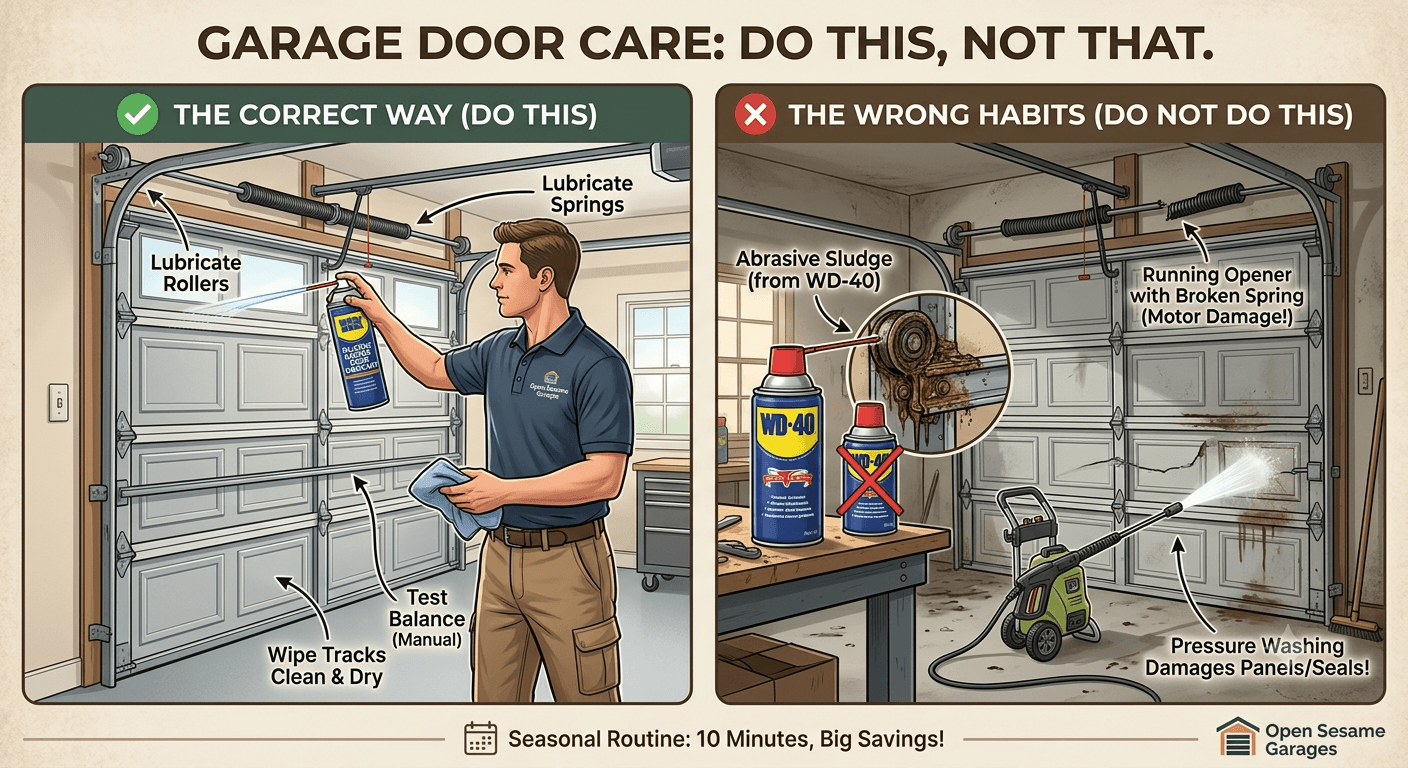
Why it hurts the door: WD-40 is a water-displacement solvent, not a lubricant. It strips away existing grease, then leaves a thin film that attracts dust and grit. Over months, that film turns into an abrasive sludge that increases friction on rollers, hinges, and springs — the exact opposite of what you wanted. The extra drag forces the opener motor to work harder and wear out early.
Do this instead: Use a silicone- or lithium-based garage door lubricant on rollers, hinges, springs, and the opener rail every 3–6 months. Never lubricate the tracks — they should be wiped clean and dry.
2. Pressure washing the door
Why it hurts the door: A pressure washer can dent steel panels, chip paint and powder coat, force water into panel seams, and shred the weather seal along the bottom of the door. Wood doors fare even worse.
Do this instead: Wash the door twice a year with a garden hose, mild dish soap, and a soft brush or sponge. Rinse top to bottom and let it dry before operating.
3. Ignoring new noises
Why it hurts the door: Grinding, squealing, popping, and rattling are the door telling you exactly which part is failing — worn rollers, loose hardware, dry hinges, or a spring near the end of its cycle life. A $10 fix ignored for six months becomes a $300 repair.
Do this instead: Treat any new sound as a service flag. Tighten loose bolts, lubricate moving parts, and if a noise persists or gets louder, have a technician look before something snaps.
4. Running the opener with a broken spring
Why it hurts the door: The springs — not the opener — do the lifting. A typical double door weighs 150–250 lbs, and the opener motor is only designed to guide it. Forcing the opener to hoist that dead weight strips its gears, bends the top door panel, and can bring the door down unevenly.
Do this instead: If you hear the telltale loud bang or the door suddenly feels extremely heavy, stop using the opener entirely and leave the door where it is until the spring is replaced.
5. DIY torsion spring replacement
Why it hurts the door: A wound torsion spring stores enough energy to lift a 200 lb door thousands of times. Released uncontrolled, it can break bones, cause deep lacerations, or worse. This is consistently the injury technicians warn homeowners about most.
Do this instead: Spring replacement is genuinely professional-only territory. Almost everything else on this list is safe to do yourself — this one is not.
6. Bypassing or ignoring the safety sensors
Why it hurts the door: The photo-eye sensors near the floor are what stop the door from closing on a car, a pet, or a child. Taping over them, wiring around them, or leaving them misaligned for months removes the single most important safety system the door has.
Do this instead: If the door refuses to close and the opener light flashes, clean the sensor lenses and realign them until both LEDs glow steady. It takes five minutes and restores the protection.
7. Skipping the balance test
Why it hurts the door: An out-of-balance door loads one spring and one cable more than the other. That asymmetry wears parts unevenly, pulls the door out of square, and eventually drags it off its tracks.
Do this instead: Twice a year: pull the red release cord, lift the door halfway by hand, and let go. A balanced door stays put. If it slams down or shoots up, the springs need professional adjustment.
8. Tapping the door with the car (and shrugging it off)
Why it hurts the door: Even a low-speed bump can knock rollers out of the track, bend a track bracket, or crease a panel. The door may still run, but a bent track puts stress on every cycle until a roller finally jumps out — often with the door overhead.
Do this instead: After any contact, run the door through a full open-close cycle while watching the rollers and tracks. Any wobble, gap, or scraping sound means stop and get it inspected.

The 10-Minute Habit That Prevents Most of This
Once a season: watch and listen to a full open-close cycle, wipe the tracks clean and dry, put a few drops of silicone lubricant on rollers, hinges, and springs, clean the two sensor lenses near the floor, and run the balance test. That routine catches almost every problem on this list while it is still a minor adjustment instead of an emergency call.
For the full season-by-season routine, see our garage door maintenance checklist for Oklahoma homes.
Hearing a Noise You Don't Like?
Open Sesame Garages provides free, same-day estimates and 24/7 emergency repair across Oklahoma City and the surrounding metro.